PPCA Book Selection Survey for 2026
Survey closed
Thank you to the 17 people who took the survey.
Survey #1
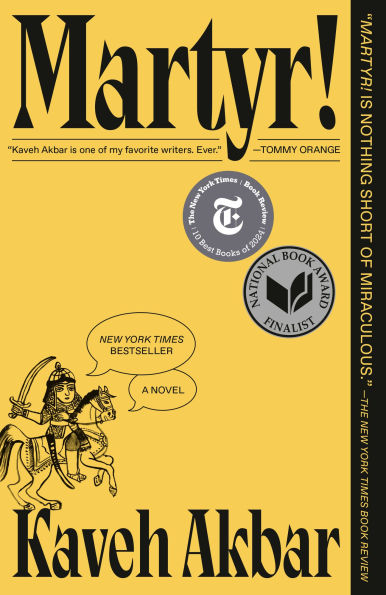
Akbar, Kevin: Martyr! (2024)
Review: ©Booklist: Orphaned, anxious, and outspoken Iranian American poet Cyrus Shams is in AA and barely scraping by. Not quite 30, he’s trying to write a book about martyrs, his obsession with meaningful deaths stemming from his mother’s perishing on the Iranian passenger airliner shot down by the U.S. navy in 1988. His bereft father left Tehran with his infant son to work at an industrial chicken farm in Indiana. The only remaining connection to Iran is Cyrus’ uncle, who suffers from PTSD after his surreal service in the Iran-Iraq War as a battlefield angel. Living with Zee in an ambiguous friends/lovers relationship, Cyrus is tipping toward suicidal. When they learn about a martyr-in-the-making, the terminally ill Iranian American artist Orkideh and her end-of-life performance piece à la Marina Abramovic at the Brooklyn Museum, the two men go to New York, leading to a staggering revelation. Poet Akbar (Pilgrim Bell, 2021) is an almost deliriously adept first-time novelist, writing from different points of view and darting back and forth in time and into Cyrus’ satirical dreams and the lives of Iranian poets from Rumi to Farrokhzad. Akbar creates scenes of psychedelic opulence and mystery, emotional precision, edgy hilarity, and heart-ringing poignancy as his characters endure war, grief, addiction, and sacrifice, and find refuge in art and love. Bedazzling and profound.
Survey #2

Albertus, Michael: Land Power: Who Has It, Who Doesn’t, and How That Determines the Fate of Societies (2025)
Review: ©Library Journal: A prolific progressive social commentator and author, Albertus (political science, Univ. of Chicago; Property Without Rights) argues that land is the fundamental source of economic, social, and political power. Over the past two centuries, what Albertus describes as the Great Reshuffle has dramatically changed ownership patterns of land worldwide. His interest is how land reform can affect economic growth, racism, gender disparities, equity for Indigenous peoples, and the environment. His scholarly research and on-the-ground examination of land use and land reform over the past 15 years (mainly in non-industrialized countries) leads Albertus to argue that redistributing acreage to the tillers of land, with accompanying clear titles and generous government assistance, can combat racism, correct gender disparities, and stimulate economic growth in a bottom-up process. He also makes the case that top-down philanthropic and governmental efforts to conserve land can help heal the environment, as it has in Chile and Spain.
Survey #3

Alharthi, Jokha, and Marilyn Booth: Bitter Orange Tree (2022)
Review: ©Publishers Weekly: Man Booker International Prize winner Alharthi (Celestial Bodies) returns with a gorgeous and insightful story of longing. Zuhour, now at university in the U.K., spent her girlhood in a small Omani village, brought up mainly by a grandmotherly woman named Bint Aamir, whom Zuhour’s grandfather Salman had charitably taken in years earlier. Bint Aamir raised Salman’s son and, eventually, Zuhour, as Salman’s wife was too mired in depression and obsessed with piety to take responsibility. Bint Aamir gradually lets go of her dreams for a plot of land to tend and a husband and children of her own, takes comfort drinking coffee in the shade of her beloved bitter orange tree, and dies just before Zuhour leaves for college. Away, Zuhour is troubled by unsettling dreams of Bint Aamir and tries to cope through therapy and friends such as the wealthy, sophisticated Pakistani sisters Suroor and Kuhl. The latter is married without the knowledge of her parents to Imran, a handsome fellow medical student of lowly, rural origins, and Zuhour, Kuhl, and Imran form an exclusive triangle. Zuhour loves both, mainly the charming, taciturn Imran, whose humility, self-sacrifice, and agricultural roots inevitably remind her of Bint Aamir and the sense of belonging she misses so much. The bittersweet narrative, intuitively translated by Booth, is chock-full of indelible images symbolizing freedom struck down, such as a battered kite and a bird ripped to shreds. This solidifies Alharthi’s well-earned literary reputation.
Survey #4

Aw, Tash: The South (2025)
Review: ©Publishers Weekly: The stellar latest from Aw (The Harmony Silk Factory) chronicles a sensitive boy’s coming-of-age and his family’s private pain. “Wayward” adolescent Jay is the youngest of the Lim family, who leave their unnamed Malaysian city during his summer break from high school for their small farm in the south. Aw evokes a mood of pervasive decline, describing the financial troubles plaguing the country, the farm’s economic problems, and the deterioration of family patriarch Jack, a severe, unlikable math teacher. Against this melancholy backdrop, Aw masterfully juxtaposes the hopes and desires of the younger generation, crystallized in the tender, slow-burning relationship between Jay and a slightly older and stronger boy named Chuan, son of the farm’s manager. Questions of how to manage one’s inheritance, whether of material assets or emotional baggage, are central to the novel, as Aw explores how the characters, especially Jay’s mother, Sui, feel indebted and trapped. Through alternating close-third perspective, and occasional first-person passages from Jay, Aw offers a clear view into the characters’ inner lives, revealing their aching desires and the secret relationships and personal crises they hide from each other. In addition to the perceptive characterizations, Aw uses rich symbolism, such as the Lims’ ever-present tamarind grove, alive and beautiful but terminally diseased. This masterwork of psychological realism brings to mind the classic novels of E.M. Forster.
Survey #5

Balibrera, Gina Maria: The Volcano Daughters (2024)
Review: ©Booklist: Balibrera’s lush historical novel, her first, is narrated by the ghosts of four young Indigenous women who lived near a volcano and were victims of the real-life 1932 El Salvadoran ethnocide called La Matanza. They recount the lives of their childhood friends Graciela and Consuela, daughters of a tenant farmer who becomes a trusted adviser of a ruthless general (inspired by Maximiliano Hernandez Martinez). When the father mysteriously dies, the general installs the younger daughter Graciela (a mere child) as an oracle to advise him on governmental matters. She and Consuela are forced to live in the palace, apart from their anguished mother. After the massacre, they eventually escape, Consuela to San Francisco and Paris, where she mingles with artists and elites; and Graciela to Los Angeles, where she is a struggling actress working in a factory. Alas, the narrative flow suffers from a lack of context for non-Spanish speakers and rambling story lines that minimize significant events in El Salvadoran history. Still, the young narrators provide irreverent commentary alongside dramatic storytelling depicting the hardscrabble lives of determined sisters yearning for better lives.
Survey #6
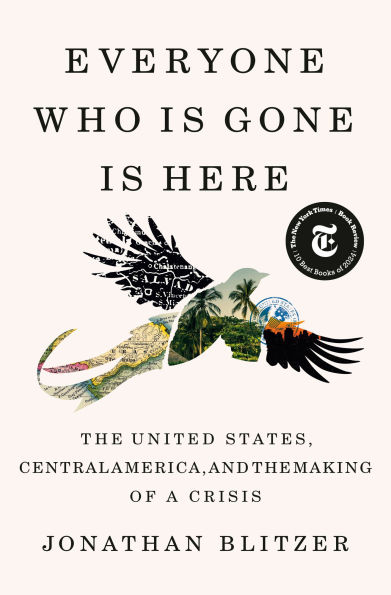
Blitzer, Jonathan: Everyone Who is Gone is Here: The United States, Central America, and the Making of a Crisis (2024)
Review: ©Booklist: Blitzer, an award-winning New Yorker staff writer, presents an engaging and accessible account detailing the myriad, often brutal ramifications of U.S. foreign policy towards El Salvador, Honduras, and Guatemala during the past several decades. He employs a conversational tone, effectively balancing in-depth investigative reporting with personal narration as he weaves together the stories of individuals caught up in the evolving turmoil wreaked by both Democratic and Republican policy makers. This historical perspective makes for compelling reading as it brings the lives of people in each country into focus and helps readers make sense of complicated past events that are informing urgent current controversies and actions.
Survey #7

Carstensen, Jeanne: A Greek Tragedy: One Day, A Deadly Shipwreck, and the Human Cost of the Refugee Crisis (2025)
Review: ©Kirkus Reviews: An up-close look at an ongoing calamity. Syria’s civil war and America’s debacles in Afghanistan and Iraq have forced millions to flee their homes; 35% of these are children. Many refugees attempt to reach Europe. In response, Western nations have hardened their hearts, built walls, and reinforced border guards, but desperate families keep trying. Journalist Carstensen follows four subjects in her searing first book: an Afghan bank official traveling with his wife and two children, a 13-year-old Afghan girl who flees with her parents and three siblings, a school counselor, and a young female artist from Syria. Immigration opponents maintain that these are the dregs of society. In fact, poor people rarely emigrate. It’s too expensive. For example, the Afghan bank official pays smugglers $25,000 to convey his family to Europe. Simply crossing a few miles of ocean from Turkey to a Greek island costs thousands. Carstensen describes their miserable journey driven by rapacious, penny-pinching smugglers. The final leg to safety involves crossing five miles to Lesvos, a Greek island, on fragile rubber rafts or broken-down boats. In 2015 refugees began arriving–cold, wet, exhausted, often as bodies washed up on the shore. Greece’s government was hostile and remains so; U.N. and international aid groups responded slowly, but Carstensen emphasizes a minority of islanders, local fishermen, and foreign volunteers who rescued many and provided food, shelter, and medical care so well that the island was nominated for a Nobel Peace Prize. She focuses on Oct. 28, 2015, when smugglers crammed 300 refugees into a decrepit hulk that fell to pieces halfway across. Despite heroic rescue efforts, about 80 died, more of them children because they spent hours in cold water and are more susceptible to hypothermia. Carstensen’s four subjects survived, but not their families. A vivid snapshot of a broken asylum system.
Survey #8

Desai, Anita: Rosarita (2025)
Review: ©Booklist: Everything Bonita thought she knew about her past is abruptly thrown into question when an older woman attired in layers of colorful skirts accosts her in El Jardin de San Miguel. Bonita has traveled from India to Mexico to study Spanish and is taken aback by this theatrical woman’s insistence that she knew Bonita’s mother, Rosarita, when she was Bonita’s age and in San Miguel to study painting. Bonita says that’s impossible; her mother, Sarita, was not an artist and never went to Mexico. But flashbacks to mysterious moments in her childhood prod Bonita into accompanying the stranger she dubs the Trickster on a journey allegedly retracing her mother’s footsteps. Shortlisted thrice for the Booker, Desai is exceptionally attuned to the power of suggestion, tug of secrets, mutability of memories, and the anguish of women denied lives of their choosing. Her profound sense of place yields exquisitely rendered scenes saturated with the land’s bloody past and the traumas families inherit. As Bonita’s quest leads her to the sea, Desai leaves us stunned by nature’s glory and humanity’s capacity for horror and joy, loneliness and love.
Survey #9

Fairbanks, Eve: The Inheritors: An Intimate Portrait of South Africa’s Racial Reckoning (2022)
Review: ©Publishers Weekly: Apartheid’s legacy of inequality and alienation is outlined in this searching debut from American-born journalist Fairbanks, who moved to South Africa in 2009. Documenting the fallout from the end of sanctioned white supremacy in 1994, Fairbanks focuses on Dipuo (no last names given), a former African National Congress militant who organized against the apartheid government in Soweto in the early 1990s and participated in violence against Blacks suspected of collaboration, and her daughter Malaika, a Black Consciousness activist who protests the ongoing marginalization of Black South Africans. Fairbanks also spotlights Christo, a white lawyer and ex-soldier who fought the ANC in the early 1990s–killing a Black civilian–and is now active in an Afrikaner cultural revival that casts whites as the besieged minority. Fairbanks’s vivid reportage depicts a South Africa awash in racial unease and false consciousness: whites are beset by a sense of dispossession and imperilment–largely unjustified, she argues–tinged with guilt; Blacks, frustrated by intractable poverty and the ANC government’s inability to deliver economic development, denounce systemic racism while wondering if their failures vindicate racist assumptions. Distinguished by its sympathetic yet clear-eyed viewpoint, this vital study lays bare the complex, agonizing predicaments that flow from South Africa’s tragic past.
Survey #10

Garricks, Chimeka: A Broken People’s Playlist: Stories (from Songs) (2020/2023)
Review: ©Booklist: A dozen interlinked, music-oriented stories set in Port Harcourt, Nigeria, where Garricks was raised, form an ode to feel-good moments (falling in love, finding second chances, reveling in gratitude) and grating dissonances (cheating spouses, living with regret, longing for forgiveness, grieving for a loved one). Readers will feel both bewildered by and invested in the interconnected and fractured lives of friends, lovers, and family members who long for peace and redemption. In Music, an aspiring DJ vows never to follow his womanizing father’s footsteps, but later in Desperado, heartbreaking details emerge as to why he was unable to keep his promise. In Hurt, a pampered son stages his own funeral as his older brother, also seen in Love’s Divine, tries to make up for his shortcomings. In the City presents a young man with a promising future caught in the crosshairs of police brutality. River highlights the violence in confraternities (secret student groups) in Nigerian universities. Friends ponder the meaning of true love, “when you’ve unloved the unlovely, the imperfect,” in Beautiful War. Each songlike story feels like a breakout hit encapsulating the brokenness and the beauty in life’s soundtrack.
Survey #11

Gurnah, Abdulrazak*: Theft (2025)
* 2021 Nobel Prize in Literature
Review: ©Publishers Weekly: Two Tanzanian men, abandoned as boys, forge their own paths in this incisive novel by Nobel Prize winner Gurnah (Afterlives). Karim’s Muslim parents divorce when he is a boy. His mother, Raya, feels no affection for him, and abandons him to her father after falling in love with a man named Haji Othman. Years later, Badar, a 10-year-old orphan boy, enters the Othman household as a domestic servant for Raya, who’s now married to Haji. As the novel unfolds, Badar is revealed to be Haji’s nephew, cast off by his wayward brother and hated by Baba, the household’s elderly and devout patriarch. Karim becomes aware of Badar’s plight during a visit home from university, when Badar is 15. Two years later, when Baba suspects Badar of stealing groceries on the family’s credit, he instructs Haji to banish the teenager. Badar goes to live with Karim, now a married low-level bureaucrat in Zanzibar, and both men rise through the ranks of their respective fields, with Badar’s hotel busboy job leading to an assistant manager position and Karim on track to become a government minister. By the novel’s end, their series of cosmopolitan encounters have driven one to abandon his Tanzanian identity and the other to reinvest in it. Written in lucid prose, Gurnah’s tale is at once culturally specific and emotionally universal, especially in depicting Badar’s heartache as a boy and the strangeness of his arrangement with the Othman household as seen from Karim’s point of view. Gurnah is at the top of his game.
Survey #12

Lemus, Jared: Guatemalan Rhapsody: Stories (2025)
Review: ©Booklist: The men in Lemus’ debut mélange of short stories exist in desperate circumstances. Some are in rural Guatemala: a monkish member of a cultlike group and a niño have a mystical encounter in a remote jungle village; at a hotel in the jungle, the different management strategies of two brothers have dire consequences. Other characters are in American cities: a dishwasher who hopes to win a tattoo contest, a janitor at an elite college befriended by the new security guard whose hiring has put his job in jeopardy. Lemus’ characters have been negatively impacted by contact with the U.S. through immigration and deportation (themselves or family members) and even by entitled American tourists. The narrative voice dances between third and first person from story to story and pirouettes through the first-person plural in a tale about a soccer team of privileged youths being coached by a washed-up former star hired by their parents. Each story is beautifully bleak as it depicts unique situations; a few, like the inventive story in which the protagonist ponders two potential endings for himself—he takes the path of a sad-sack junkie or he cleans up and becomes a bus driver to help others like the bus driver who helped him—offer welcome glimmers of hope.
Survey #13

Madalosso, Giovana: The Tokyo Suite (2025)
Review: ©Booklist: Brazilian writer Madalosso’s English-language debut opens with a kidnapping. Sweaty with nerves, nanny Maju will take four-year-old Cora from São Paulo over the border to Paraguay, where she can get the girl a new passport, then to the southern Brazilian state where Maju spent her impoverished childhood, raised by her grandmother. Cora’s mother, Fernanda, distracted by her high-profile TV job and a scorching affair, doesn’t learn anything is amiss until late that evening. In Maju’s and Fernanda’s alternating first-person perspectives, chapters fly over the course of this day, with Madalosso’s prose, translated by Lobato, becoming more unsettling and meaningful as Maju loses her grasp on what she’s doing, and Fernanda envisions every worst case. Obsessed with cleanliness and prayer, Maju is paid well but lost everything, we learn, to work for Fernanda, a woman who literally buys a car when it will get Cora a vaccine. Fernanda, meanwhile, is dedicated to her demanding career but harbors a shadow truth: the work supports her family yet precludes her from mothering. You had fun with her, she tells Cora’s father. I passed by her like a cumulonimbus. A bitter and loving, eviscerating, suspenseful, and tender psychological novel about class, gender, motherhood, and nature both within and without.
Survey #14

Mengiste, Maaza: The Shadow King (2019)
Review: ©Booklist: Mengiste’s indelible first novel, Beneath the Lion’s Gate (2010), put Ethiopian historical fiction on countless best-of, must-read, and award lists. Her monumental new novel draws inspiration from her great-grandmother, who as the eldest and in Mulan-style answered Emperor Haile Selassie’s demand for first sons to fight against Fascist Italy despite her father’s objections, insisting that her brothers were too young. In her author’s note, Mengiste explains that her brave predecessor “represents one of the many gaps in European and African history, namely, Ethiopian women who fought alongside men. In1974 in the novel, just before Selassie is dethroned, Hirut arrives in Addis Ababa bearing a box filled with “the many dead that insist on resurrection.” Almost four decades earlier, in 1935, Hirut was an orphaned servant who followed her master, Kidane, and his wife, Aster, into battle against Mussolini’s invading troops. The women are initially relegated to being caretakers but prove themselves to be fierce as warriors. Hirut eventually plays servant to the titular Shadow King, a stand-in for the secluded emperor, who remains safe in England while his country bleeds. Mengiste’s extraordinary characters—shrewd Kidane, militant Aster, the enigmatic cook, narcissistic Italian commander Fucelli, conflicted photographer Ettore, elusive prostitute Fifi, even haunted Selassie—epitomize the impossibly intricate ties between humanity and monstrosity, and the unthinkable, immeasurable cost of survival.
Survey #15

Mushtaq, Benu, and Deepa Bhashti: Heart Lamp: Stories* (2025)
* 2025 International Booker Prize
Synopsis: In the twelve stories of Heart Lamp, Banu Mushtaq exquisitely captures the everyday lives of women and girls in Muslim communities in southern India. Published originally in the Kannada language between 1990 and 2023, praised for their dry and gentle humour, these portraits of family and community tensions testify to Mushtaq’s years as a journalist and lawyer, in which she tirelessly championed women’s rights and protested all forms of caste and religious oppression. Written in a style at once witty, vivid, colloquial, moving and excoriating, it’s in her characters – the sparky children, the audacious grandmothers, the buffoonish maulvis and thug brothers, the oft-hapless husbands, and the mothers above all, surviving their feelings at great cost – that Mushtaq emerges as an astonishing writer and observer of human nature, building disconcerting emotional heights out of a rich spoken style. Her opus has garnered both censure from conservative quarters as well India’s most prestigious literary awards; this is a collection sure to be read for years to come.
Survey #16

O’Neill, Joseph: Godwin (2024)
Review: ©Publishers Weekly: A Pittsburgh grant writer forays into the world of international soccer in the exciting and incisive latest from O’Neill (Netherland). Mark Wolfe belongs to a co-op of freelance technical writers called the Group. After a client complains about his condescending attitude, the co-op’s cofounder, Lakesha Williams, suspends Mark’s dues payments for two weeks so he can take time to get his head together. His half brother Geoff, a British sports agent, enlists his aid in tracking down a teenage soccer player, known only as Godwin, whose skills impressed Geoff in an online video. Mark leaves his wife and child for England, then France, where he reluctantly partners with an unsavory scout named Jean-Luc Lefebvre, who travels to Benin on their behalf in search of Godwin. With Mark heading back home, O’Neill turns to Lefebvre’s adventures in Benin, which involve potholes, mosquitoes, and an endangered species of dog. It would be a spoiler to reveal what Mark learns over the course of his and Lefebvre’s attempt to recruit Godwin, or how the backroom dealings at the Group impact him and Lakesha. As O’Neill artfully pairs the thrill of the hunt for Godwin with the complex politics of cooperative work, the driving force that connects the twinned narratives is the corruptive power of capitalism. This has all the velocity and swerve of an unstoppable free kick.
Survey #17

Onyebuchi, Tochi: Harmattan Season (2025)
Review: ©Publishers Weekly: The melancholy antihero of this searing indictment of colonialism from World Fantasy Award winner Onyebuchi (Goliath) walks the mean streets of an unnamed West African city that’s trembling on the verge of an election between a charismatic indigenous rebel leader and a corrupt puppet of the French occupation. As the annual Harmattan dust storms gather strength, a girl bleeding from an abdominal wound stumbles into the squalid flat of clientless private investigator Boubacar, a half-French, half-native “chercher” (finder of lost persons) who fought for the French in a past war. Their encounter is brief before the girl mysteriously disappears without a trace, sending Boubacar on an odyssey of political and personal discoveries, and forcing him to face his actions in the war. The Harmattan winds both hurt and help along the way. Blending elements of classic noir fiction (including a Chandleresque narrative voice) and fantastic acts of terroristic martyrdom, Onyebuchi crafts an equally heady and page-turning narrative. This is an unforgettable portrait of a place and a person trapped between two worlds and two cultures.
Survey #18

Oza, Janika: A History of Burning (2023)
Review: ©Kirkus Reviews: Four generations of an Indian family struggle with displacement in this debut novel. Artfully juggling the perspectives of 10 characters over the span of nearly a century, Oza follows the members of an ordinary family from India to Africa to Canada as they struggle to maintain their cultural traditions and solidarity amid an often hostile environment and changing social norms. Pirbhai, the patriarch, is lured to Africa as a 13-year-old in 1898, where he’s pressed into indentured servitude laying track for the British railway to Lake Victoria. His fateful decision to obey an order to set fire to a village the British wanted gone provides the novel’s title and looms over his descendants as a sort of original sin. After he moves from Kenya to Uganda, his family slowly climbs the economic ladder into the middle class until the moment in 1972 when the dictator Idi Amin orders the expulsion of all Asians. When Arun, an anti-government activist, disappears following his arrest, his wife, Latika, Pirbhai’s granddaughter, allied with her husband in the struggle against the repressive regime, chooses to remain behind rather than joining her parents, siblings, and her own infant son on their journey to Toronto and the beginning of a new life in yet another alien land. The family’s fears about her fate give birth to a secret that will reverberate in their lives decades later. Oza subtly observes the shift from practices like arranged marriages to unions that are the product of romantic attachments and trusts her readers to acclimate themselves. In intimate domestic scenes and scenes of societies in turmoil, she displays a sure-handed ability to write at both small and large scale and to portray with deep sympathy the universal human desire to find “a little place to simply exist, freely, and with dignity.” An ambitious family drama skillfully explores the bonds of kinship and the yearning for peace and security.
Survey #19

Reva, Maria: Endling (2025)
Review: ©Publishers Weekly: In Reva’s astonishing metafictional tale (after Good Citizens Need Not Fear), a Ukrainian Canadian writer named Maria Reva attempts to write a novel about Ukraine’s mail-order bride industry on the eve of the Russian invasion. The novel’s first part consists of Reva’s novel in progress featuring Yeva, a snail conservationist working to save a species on the brink of extinction by traveling around the country in her RV turned lab to find specimens for breeding. To pay for her equipment, she joins guided romance tours and goes on dates with Western men looking for a pliable Ukrainian bride. Meanwhile, sisters Nastia and Sol strive to take the bridal industry down. After Nastia borrows Yeva’s RV with a plan to kidnap 12 of the bachelors, Russia invades and Reva’s manuscript grinds to a halt. Reva emerges as a character in the second part, reeling from the bombings and worrying about her grandfather, who still resides in occupied Kherson, as she watches the news from Vancouver. She disappoints her agent with the news that she’s quit the novel (“I was writing about a so-called invasion of Western bachelors to Ukraine, and then an actual invasion happened…. To continue now seems unforgivable”). Reva then writes a grant proposal to travel in Ukraine for research on a “postnovel” about her birth country in flux. When she returns in the final section to her three revolutionary anti-brides, their adventure brilliantly dovetails with Reva’s literary experiment and wartime reckoning. This inspired and urgent novel is bound to make a major splash.
Survey #20

Sarr, Mohammed Mbougar, and Lara Vergnaud: The Most Secret Memory of Men* (2021/2023)
* 2021 Prix Goncourt
Review: ©Kirkus Reviews: A struggling Senegalese novelist falls deeper and deeper into a shadowy maze of literature and history. At the heart of this tale of literary identity is the mysterious (and fictional) Senegalese author T.C. Elimane and his 1938 novel, The Labyrinth of Inhumanity, a book that narrator and struggling 21st-century novelist Diégane Latyr Faye believes to be so brilliant, so profound that, upon reading it, “violent, pure life would come coursing back through your veins.” In the midst of trying to write his own masterpiece, Faye, also Senegalese and Paris-based, encourages his clique of writers to help him raise the banner for Labyrinth as a lost, liberating work of African literature. Upon researching the novel’s murky history, Faye discovers that it had incited polarizing debate in francophone Africa’s literary coteries. From what he can tell, the work pierced Parisian society like a bullet, made a harrowing mark, then disappeared along with its author. Faye decides he must find out what happened to Elimane while searching for the truth of his own murky identity. In time, he questions whether literature for him is a sort of windowpane, or even a shield, behind which he shelters in avoidance of life’s “battering ram to the gut.” Sarr investigates with keen psychological detail Faye’s and Elimane’s “foreign”-ness, their oft-patronized “exoticism,” their battles with the realities of homeland and the non-being of expatriate life in France. Faye’s and his peers’ tipsiness before the lure of lasting fame, or at least Instagram notoriety, the constant hum of gossip by which they are encircled, the bitter critical dismissals—all the elements of the writer’s consciousness are set out painstakingly. In the end, to whom who can Faye be faithful? How will he define himself, particularly on those nights when the sky, like Elimane’s chef-d’oeuvre, is “a labyrinth too, and it’s no less inhuman than the labyrinth of the earth”? Translated by Vergnaud, Sarr’s novel, though self-conscious and on occasion self-indulgent, nevertheless justifies itself as the winner of the 2021 Prix Goncourt, one of France’s most prestigious literary prizes. Despite its self-fascination, a novel of undoubtable prowess.
Survey #21

Shree, Geetanjali, and Daisy Rockwell: Tomb of Sand* (2018/2021)
* 2022 International Booker Prize
Review: ©Publishers Weekly: This alluring, International Booker–winning saga from Shree (The Empty Space) employs magical realism to recount a matriarch’s rebirth in contemporary India. After Ma’s husband dies, she refuses to get out of bed, leaving her oldest son, Bade; his wife, Bahu (also known as “Mem Sahib,” which means white woman living in India); his sons Siddharth and Serious Son; and his feminist sister, Beti, to worry. After receiving a cane covered in colorful butterflies from Overseas Son, Ma holds the cane up and says, “I am the Wishing Tree. I am the Kalpataru.” From there, she gives away most of her possessions and disappears. Later, Ma returns–not to her wealthy son, Bade, but to Beti, and bonds with her old friend Rosie Bua, a hijra who understands the power of the Wishing Tree. The prominent characters’ names are honorifics (“beti” means daughter), as in the charactonyms of E.L. Doctorow’s Ragtime, and Ma goes on to challenge expectations of her role as a mother in her rebirth by pursuing autonomy and enlightenment. The leisurely pacing and drawn-out accounts from the various characters make for a slow burn, but Rockwell does a lovely job preserving the Hindi wordplay in Shree’s kaleidoscopic epic. This is worth signing up for the long haul.
Survey #22

Thanki, Asha: A Thousand Times Before (2024)
Review: ©Publishers Weekly: Thanki debuts with a gorgeous fantastical tale of family history and political strife, spanning from the 1947 Partition of India to the present. It’s told by Ayukta, a Brooklyn artist, to her partner, Nadya, by way of explaining why she’s hesitant to have children. Ayukta’s family has an ancient magical tapestry, and when a new family member is sewn into it, the person receives the ability to shape the future. As Ayukta gradually reveals over the course of the novel, the special powers conferred by the tapestry can be a curse. She begins the story with her grandmother, Amla, growing up in Karachi when the Partition throws daily life into disarray. Amla’s mother, Chandini, sews Amla’s image into the tapestry, but she is unable to explain the gift to Amla before dying in a sectarian riot. When Amla’s friend is raped, Amla inadvertently kills the rapist by depicting his death in a painting, and suspicion falls on her father after police find the painting in their house. Later, Amla passes the gift on to her more cautious daughter, Vibha, rather than to Ayukta’s mother, Arni, drawing Arni’s outrage. Thanki threads her saga with rich themes, including mother-daughter tensions, the burden of inheritance, and the power of art. Readers won’t want this to end.
Survey #23

Tokarczuk, Olga*, and Antonia Lloyd-Jones: The Empusium: A Health Resort Horror Story (2022/2024)
* 2018 Nobel Prize in Literature
Review: ©Publishers Weekly: Nobel Prize winner Tokarczuk (The Books of Jacob) delivers the disarming tale of a Silesian tuberculosis ward and a series of mysterious deaths in the surrounding countryside. Mieczyslaw Wojnicz, a frail engineering student, has been sent to the ward in 1913 to convalesce. While awaiting a room in the main facility, he chats in the guesthouse with a group of fellow patients, whose misogynistic views reflect the period’s prevailing attitudes. Tokarczuk places the modern institution against a rural backdrop where locals remain enthralled by ancient folk superstitions, and she explores this dissonance as Wojnicz learns of the witch trials that purportedly drove some women into the wilderness centuries earlier and gave rise to legends of female shape-shifters. Each November, the bodies of mutilated men are recovered from the woods, and hikers stumble upon Tuntschi, female dolls fashioned from natural materials to gratify sex-starved itinerant laborers. At the novel’s crisis point, Wojnicz uncovers a chilling connection between the legend and the sanatorium. Tokarczuk concocts a potent blend of horror tropes and literary references (Franz Kafka, Thomas Mann) as she realizes the potential of her tale’s uncommon setting—a community set apart by the omnipresence of sickness and death, where the rules of civilized propriety give way to more fantastic possibilities. Readers will find much to savor.
Survey #24

Trabucco Zerán, Alia, and Sophie Hughes: Clean (2022/2024)
Review: ©Publishers Weekly: Chilean writer Zerán (The Remainder) delivers a propulsive story of class differences in Santiago. After Julia, the young daughter of a successful doctor and lawyer, is found dead, having drowned in the family’s pool, Estela, their longtime maid, is brought in for questioning. Sitting in an interrogation room, Estela recounts her decision to leave her home in her mid-30s to find work in the capital and divulges information about her employers. She describes stumbling upon them having sex in the dining room and retreating when they notice her, after which their cries get much louder. In addition to cleaning, she’s forced to double as a nanny for the “fragile” Julia, and she learns secrets about the family, such as the mother’s use of birth control pills and antidepressants. Zerán employs Estela as the novel’s lone narrator, smartly crafting a version of events that suggests the maid’s innocence, even as Estela admits to bottling her rage, leaving the reader to wonder whether Julia’s death was accidental, a suicide, or murder. Though Estela’s recollections become repetitive as the novel’s climax nears, Zerán keeps up the momentum with short chapters and Estela’s appealingly snappy voice (she frequently tells her interrogators to “write this down”). This is bursting with intrigue.
Survey #25

Yang, Yuan: Private Revolutions: Four Women Face China’s New Social Order (2024)
Review: ©Booklist: The nation of China has experienced unprecedented economic reform over the past five decades, offering seemingly limitless possibilities—but also unimaginable competition. Hundreds of thousands of students vie for admission into top universities each year, and there can be tens of thousands of applicants for a single professional job posting. This engaging offering follows four women from childhood to the current day as they navigate city life and establish careers, documenting their struggles with school admissions and quotas, educational scams, unsafe working conditions, forays into social activism, and family and corporate intrigues. Alternating chapters allow each subject’s story to emerge, and while personal details vary (one spent her early years in a remote village with her great-grandparents, another discovered her true vocation while teaching soldiers basic English greetings in preparation for the 2008 Olympics), similarities emerge: intense pressure exerted by the one-child policy, needed support from other women, and shared dedication to hard work (evidenced by an inability to function during time off from factory shifts). There are no happy endings; these women’s experiences continue to morph along with new, twenty-first century realities. This very readable account offers rare and unblinking insights into modern China.